Making Eye Hygiene Easier: A Guide for Parkinson’s Patients and Caregivers
At The Bye Co., we talk to people every week who are quietly struggling with something most eye care brands never mention: the products themselves are hard to use. As optometrists, we hear it most often from people living with Parkinson’s and the family members who care for them. Tremor, stiffness, and reduced fine motor control can turn a “simple” eyelid wipe into a frustrating daily battle — and when hygiene routines become difficult, they tend to get skipped. In this guide, we explain why eye hygiene matters so much in Parkinson’s, why traditional wipes and gels so often fail people with limited dexterity, and how a simpler approach can help patients and caregivers alike.
Why Eye Hygiene Matters More in Parkinson’s
Parkinson’s doesn’t just affect movement — it affects the eyes in ways many people don’t expect. A reduced blink rate is common, which means the tear film isn’t refreshed as often and the eyes dry out more quickly. Many people also experience changes in the oily secretions along the eyelid margins, allowing debris, crusting, and bacteria to build up on the lids and lashes.
Together, these changes make two conditions far more common in Parkinson’s:
- Blepharitis — inflammation of the eyelid margins, causing redness, itching, crusty lashes, and gritty discomfort.
- Dry eye — burning, watering, blurred vision, and tired, irritated eyes, often made worse by reduced blinking.
The standard advice for both is daily lid hygiene. It genuinely works — but only if the routine is one the person can actually do, day after day.
The Problem With Wipes and Gels When Dexterity Is Limited
Most eyelid hygiene routines were designed for people with steady hands. They assume you can tear open a foil sachet, unfold a small wipe, hold it taut between your fingertips, and scrub precisely along a lid margin only a few millimetres wide — all without poking your own eye.
For someone with Parkinson’s, every one of those steps can be a barrier:
- Opening the packet. Foil sachets and small flip-top tubs demand pinch strength and precision that tremor and rigidity make difficult. We’ve heard from patients who give up before the wipe is even out of the wrapper.
- Controlling the wipe. Guiding a small piece of fabric accurately along the lash line requires fine motor control. With a tremor, it’s easy to miss the lid margin entirely — or to press too hard on delicate skin.
- Gels and scrubs add steps. Squeezing out the right amount, massaging it in, then rinsing it off usually means standing at a bathroom sink for several minutes. For someone with balance or mobility difficulties, that’s tiring at best and unsafe at worst.
- Twice a day, every day. Lid hygiene only works with consistency. A routine that’s exhausting once is a routine that gets abandoned.
None of this is a failure of effort. It’s a failure of product design — and it’s exactly why we believe the format of eye hygiene matters just as much as the formula.
What Is Hypochlorous Acid — and Why Should You Care?
We understand the hesitation here. Most people have spent years being told to use wipes and gels, so when we suggest spraying something onto closed eyelids, the first question is usually: “What actually is it, and why would I switch?”
Hypochlorous acid (HOCl) is a substance your own body already makes. Your white blood cells produce it naturally to fight bacteria and calm inflammation — it’s part of your immune system’s everyday toolkit. When it’s produced through electrolysed purified water, as in our formulas, you get that same gentle antimicrobial action in a bottle: no alcohol, no preservatives, no fragrance, and no sting.
For eyelid hygiene, that means hypochlorous acid can:
- Reduce the bacterial load on the eyelid margins that drives blepharitis and stye formation
- Soothe irritated, inflamed lid skin rather than aggravating it
- Cleanse without scrubbing, rinsing, or residue
In other words, it does the job a wipe is trying to do — without asking your hands to do the hard work.
Why a Spray Changes Everything for Limited Dexterity
This is where format becomes the whole story. Our BYE STYE hypochlorous facial mist turns a multi-step scrubbing routine into something far simpler: close your eyes, spray, and let it dry. There’s nothing to tear open, nothing to unfold, nothing to rinse off, and no need to navigate a tiny wipe along the lash line with shaking hands.
For Parkinson’s patients, that means:
- One motion instead of many. Pressing a spray nozzle is a single, gross-motor action — far more achievable than the pinch-tear-unfold-scrub sequence a wipe demands.
- No bathroom required. The mist can be used sitting in a chair, at the bedside, or wherever is comfortable and safe. No standing at a sink, no rinsing.
- Independence preserved. Many people can manage a spray themselves long after wipes have become impossible — and keeping ownership of a daily routine matters enormously for dignity and wellbeing.
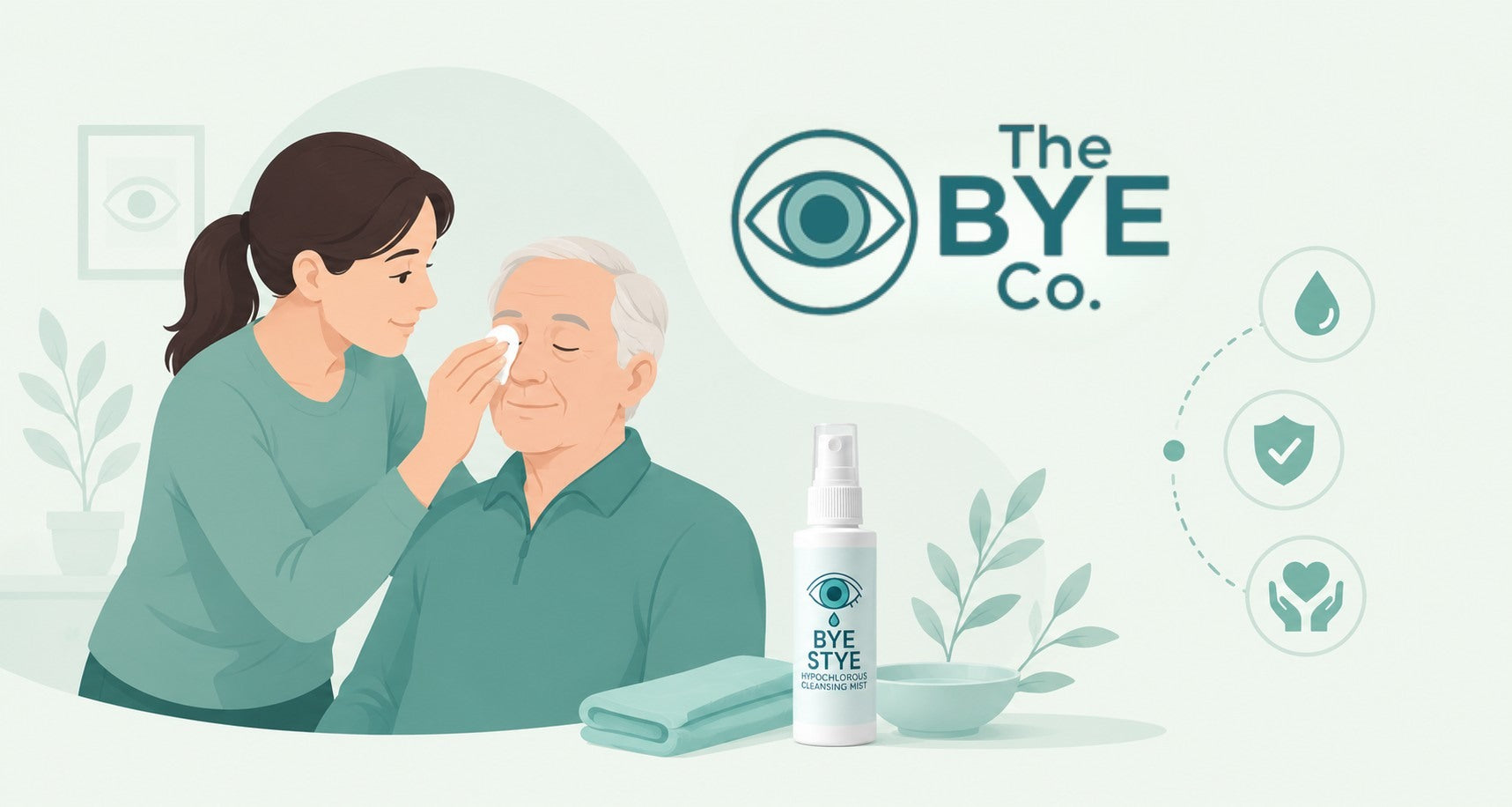
- Easier for caregivers too. If a carer does need to help, misting closed eyelids is quicker, gentler, and far less invasive than scrubbing someone else’s lash line.
A hygiene routine only protects your eyes if it actually happens. The easier we make it, the more consistently it gets done — and consistency is what keeps blepharitis and styes at bay.
A Simple Daily Routine for Patients and Caregivers
Here’s the straightforward routine we recommend. It takes under a minute, twice a day:
- Sit comfortably. There’s no need to stand at a mirror or sink.
- Close the eyes and spray. Hold the mist about 10–15cm away and apply one to two sprays across the closed eyelids.
- Let it air dry. No rinsing, no rubbing. If preferred, gently pat with a clean tissue.
- Hydrate if needed. If dry eye is part of the picture, follow with a preservative-free drop such as our BYE DRY EYE preservative-free eye drops, formulated with 0.1% sodium hyaluronate for lasting moisture without additives that irritate sensitive eyes.
Tips for Caregivers
- Time it with medication. If tremor improves when medication is working well, schedule eye care for those “on” periods so your loved one can do as much as possible themselves.
- Keep it within reach. A spray bottle on the bedside table or by a favourite chair removes the trip to the bathroom entirely.
- Make it a cue, not a chore. Pairing the spray with an existing habit — morning tea, the evening news — helps the routine stick without feeling like another medical task.
- Watch for warning signs. Increasing redness, pain, light sensitivity, or changes in vision warrant a visit to an optometrist or GP. Good hygiene prevents many problems, but it doesn’t replace professional care.
Where Wipes Still Fit In
We’re not against wipes — we make them. For carers assisting with a more thorough clean, or for patients whose dexterity allows it on good days, our BYE BLEPH biodegradable eyelid wipes use the same gentle electrolysed water formula, free from preservatives, alcohol, and fragrance. Many families find a combination works best: the spray for everyday independence, and a wipe when a caregiver is lending a hand.
Gentle Care, Made Simpler
Everything we make at The Bye Co. is designed by optometrists, tested by dermatologists and ophthalmologists, and built around one belief: eye care should be gentle on your eyes, your hands, and the planet. Our bottles are refillable, our wipes biodegradable, and our formulas free from alcohol, preservatives, parabens, and fragrance.
If you or someone you love finds eye hygiene harder than it should be, you don’t have to keep fighting with foil sachets. Explore our full range of gentle eye care essentials and find a routine that finally fits the hands that have to use it.

Written by Sanaan Akhter