Dry Eyes On Long Flights: Cabin Air Survival Guide
We built The BYE Co. in airport lounges. Our founder is a practising optometrist who spent years travelling between practices across the UK and over to Northern Ireland, and the pattern was always the same: long days, recycled air, unfamiliar environments, and eyes that felt gritty and irritated by the time the wheels touched down. If you have ever landed after a red-eye feeling as though someone had swapped your tear film for sand, this article is for you.
Below we break down exactly what airline air conditioning does to your eyes, who feels it worst, and the simple routine we pack for every flight.
Why airline cabins are so hard on your eyes
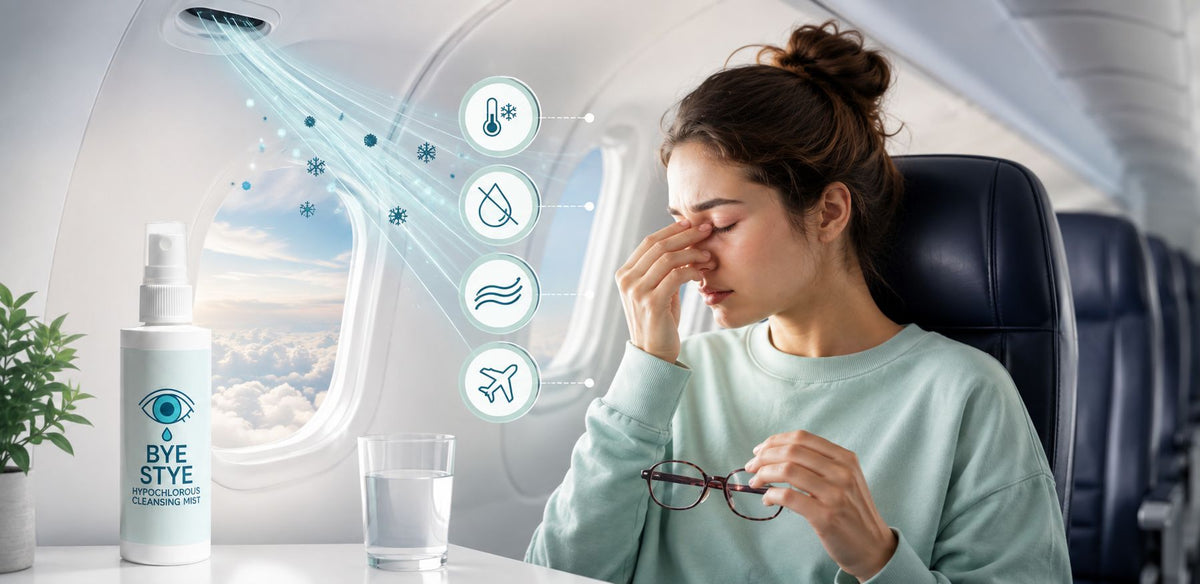
Commercial aircraft pressurise the cabin using air drawn from outside at cruising altitude. At 35,000 feet that air is extremely cold and holds almost no moisture, so once it is compressed and warmed for the cabin it arrives bone dry. Relative humidity in a long-haul cabin typically sits somewhere between 10% and 20% — drier than the Sahara, and far below the 40–60% your eyes and skin are happiest in.
Your tear film is a thin three-part structure: a mucin layer that grips the eye surface, a watery layer that hydrates it, and an oily lipid layer on top that stops the water evaporating. Dry, fast-moving cabin air attacks the weakest point in that system — evaporation.
Three things happen at once
- Accelerated tear evaporation. Low humidity plus constant airflow from the overhead gasper vent strips moisture from the eye surface faster than your glands can replace it.
- A collapse in blink rate. We blink around 15–20 times a minute normally, and roughly half that when we are locked onto a screen. Eight hours of seat-back films, laptops and phones means eight hours of incomplete, infrequent blinking — and the blink is what spreads that protective lipid layer.
- Rising tear osmolarity. As water evaporates, the salts left behind concentrate. That saltier tear film is what your nerves interpret as burning, grittiness and stinging, and it can trigger a low-grade inflammatory cycle that outlasts the flight itself.
Add cabin dust, recirculated particles, alcohol and coffee (both mild diuretics), interrupted sleep and a dose of stale air from the person reclining in front of you, and the eyelid margin — where your oil glands sit — gets a rough deal too.
The signs you are dealing with flight-related dry eye
It rarely announces itself as "dry". More often it shows up as:
- Gritty, sandy or foreign-body sensation, especially on waking mid-flight
- Watery, streaming eyes — a reflex overflow that is genuinely a dryness symptom, not the opposite
- Blurred vision that clears for a second or two after a hard blink
- Red, heavy lids and light sensitivity in the cabin or on arrival
- Contact lenses that feel welded in place after a few hours
- A tender lump forming at the lash line a day or two after landing
That last one matters. When lid hygiene slips during travel and the oil glands become sluggish, blocked glands and styes become much more likely. It is one of the reasons we formulated BYE STYE, our hypochlorous facial mist, in the first place.
Who feels it most
Contact lens wearers
A soft lens sits in the tear film and depends on it. In a dry cabin the lens surface dehydrates, grip increases and comfort falls away. On flights over four hours we would always rather you wore glasses — and if you keep your lenses in, use drops that are preservative-free and lens-compatible.
Anyone with existing dry eye or blepharitis
If your tear film is already borderline at ground level, a cabin will expose it. The same is true of inflamed lid margins: warm, dry air and a slipped cleansing routine tend to flare blepharitis within days.
Screen-heavy professionals, over-45s and post-menopausal travellers
Reduced tear production with age, hormonal change and hours of screen focus all stack on top of the cabin environment. Some medications — antihistamines, certain antidepressants and beta blockers among them — reduce tear volume too.
Our in-flight eye care routine
This is the routine we actually pack. It fits in a clear liquids bag and takes about two minutes at a time.
Before you fly
- Cleanse the lid margin at the airport. Starting a long flight with clean lashes and lids means less debris and oil to irritate a drying eye surface. We use BYE BLEPH biodegradable eyelid cleansing wipes — single sachets, one wipe per eye, no rinsing and nothing to decant.
- Swap lenses for glasses. Or at least plan to remove lenses before you sleep.
- Hydrate properly and go easy on the in-flight wine. Unglamorous, but it works.
In the air
- Close the overhead vent, or angle it away from your face. The single highest-impact change you can make. Direct airflow across the eyes multiplies evaporation.
- Use drops on a schedule, not on symptoms. Once every hour or two, before discomfort builds. BYE DRY EYE preservative-free eye drops are formulated with electrolysed purified water and sodium hyaluronate to hold moisture at the eye surface, and they are pH-balanced, contact-lens friendly and free from preservatives, alcohol and fragrance — which is exactly what you want when you are dosing repeatedly over a long flight.
- Blink with intent. Every 20 minutes of screen time, take 20 seconds and make ten slow, complete blinks — lids fully touching. This is what re-spreads the oily layer.
- Mist your lids and face when the air starts to bite. A few spritzes of hypochlorous mist over closed eyes calms the skin around the lash line without alcohol or fragrance. Hold the bottle 15–20 cm away, spray across closed lids, and let it air dry.
- Sleep with an eye mask. Many of us sleep with a small gap between the lids, and dry cabin air finds it.
After you land
Cleanse the lids again, keep the drops going for 24–48 hours, and give your eyes a screen break if you can. If redness, pain, discharge or blurred vision persists, or a lump does not settle within a week or so, see an optometrist rather than waiting it out — full usage guidance for each of our products is on our how to use our products page.
Cabin air will always be dry. Your routine is the variable you control — and doing something small every hour beats doing something drastic on arrival.
Building your travel eye kit
Our three essentials cover the three jobs a flight demands: cleanse, calm, hydrate. The mist is available on its own, in the BYE STYE Starter Kit if you want a bottle plus a refill, and with a larger 200ml eco refill pouch for topping up at home between trips — refills are part of how we keep plastic out of our packaging. You can see the full range on our products page.
Every formula is deliberately short. No parabens, no artificial fragrance, no alcohol, no harsh preservatives — you can read exactly what is in each bottle and wipe on our ingredients page, and everything is dermatologist- and ophthalmologist-tested for sensitive eyes and skin. That restraint is not marketing; it is what a repeatedly-dosed, already-irritated eye surface needs at 35,000 feet.
The short version
- Cabin humidity of 10–20% and constant airflow evaporate your tears faster than you can make them
- Screen use halves your blink rate, so the protective oily layer stops being replenished
- Shut the vent, blink deliberately, and use preservative-free drops on a timer rather than waiting for discomfort
- Clean your lids before and after flying to reduce the risk of a post-travel stye or blepharitis flare
- Wear glasses on long-haul where you can, and never sleep in your lenses
We started this company because we were tired of landing with sore eyes and nothing gentle enough to reach for. If you want to know more about the optometry behind it, our story is here, common questions are answered in our FAQs, and if you are unsure what suits your eyes you are always welcome to get in touch.
Wherever life takes you, clear and comfortable eyes should follow.

Written by Sanaan Akhter