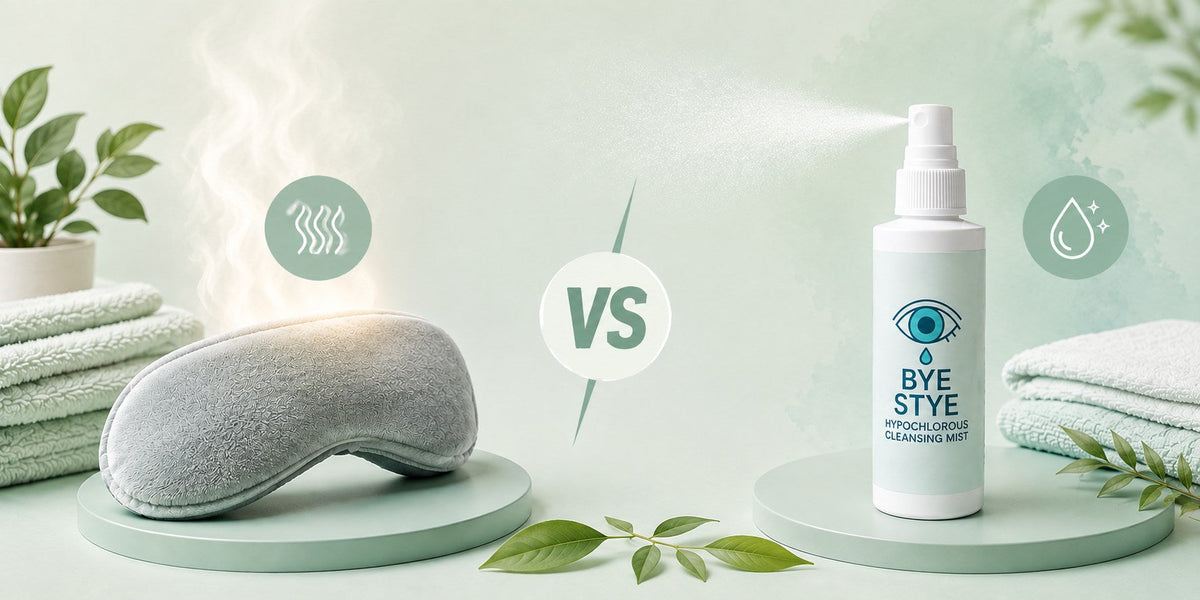
Warm Compress vs Hypochlorous Mist: Do You Need Both?
If you have ever had a stye, a flare of blepharitis, or that gritty end-of-day dryness, you have probably been told two things: use a warm compress, and keep your lids clean. What nobody explains is how those two pieces of advice fit together — or whether a hypochlorous mist replaces the flannel you have been warming up every night. We get asked this constantly, so here is our answer in full.
We are an optometrist-founded brand, and this question comes straight from the chair. Heat and hygiene are not competing options. They solve two different problems, and understanding which problem you have is what turns a routine from a chore into something that actually works.
What a warm compress actually does
Along the rim of each eyelid sit roughly 25 to 30 meibomian glands. They produce meibum — the oily outer layer of your tear film that stops tears evaporating the moment you blink. Meibum is meant to flow like warm olive oil. When the glands become sluggish, that oil thickens closer to toothpaste, plugs the gland openings, and your tears evaporate too fast. That is the mechanism behind most evaporative dry eye, and it is also why a stye or chalazion forms when a blocked gland becomes inflamed.
Heat is the only thing that fixes that specific problem. A warm compress raises lid temperature enough to soften stagnant meibum so it can be expressed with gentle massage. No cleanser, spray or wipe can do this, because the blockage is inside the gland rather than on the skin.
How to get it right
- Aim for sustained warmth, not scalding heat. Around 40–45°C for 5–10 minutes is the target. A flannel that has gone cold after ninety seconds has done very little.
- Finish with massage. Sweep gently along the lid towards the lash line, upper lid downwards and lower lid upwards, to move the softened oil out.
- Never squeeze a stye. Heat and patience, not pressure.
- Be consistent. Once or twice daily for several weeks — gland function improves slowly.
What a hypochlorous mist actually does
Hypochlorous acid (HOCl) is not an unfamiliar chemical being borrowed for skincare. It is a compound your own white blood cells produce to fight bacteria — we cover this in more detail on our ingredients page. Ours is made by electrolysing purified water, which is why the ingredient list for BYE STYE Hypochlorous Facial Mist reads simply: electrolysed purified water containing hypochlorous acid. No alcohol, no fragrance, no preservatives, no parabens.
Its job is the lid surface, not the gland interior. Along your lash line lives a normal population of skin bacteria, plus the biofilm, makeup residue, sunscreen and general debris of a day. When that load builds up, bacterial lipases break down meibum into irritating by-products, the lid margin becomes inflamed, and you get the redness, crusting and itch familiar to anyone with blepharitis. Reducing surface bacteria lowers that inflammatory pressure without stripping the skin barrier — the reason we chose HOCl over harsh cleansers in the first place.
Heat unblocks what is inside the gland. Hypochlorous mist manages what is living on the surface. Two problems, two tools.
So — do you need both?
For most people with recurrent styes or blepharitis, yes. Here is how we think about it.
Compress alone is usually enough if…
Your symptoms are purely dryness and evaporative discomfort — screens, air conditioning, long drives — with clean, comfortable lid margins and no crusting, redness or history of styes. You are treating oil flow, and heat addresses that directly. If your eyes still feel gritty afterwards, a hydrating drop such as our preservative-free BYE DRY EYE with 0.1% sodium hyaluronate supports the water layer while the compress works on the oil.
Mist alone is usually enough if…
You are managing prevention and surface hygiene rather than active blockage: mild lash-line irritation, heavy eye makeup, contact lenses, gym and travel days, or a history of styes you would rather not repeat. Misting is fast, sits neatly in an existing skincare routine, and stays effective when you are away from a hot tap — which, honestly, is why our founder built it while travelling between practices, as told on our about page.
Both, if you have an active flare or recurrent problems
When a stye is brewing or blepharitis is flaring, the two work as a sequence rather than alternatives. Heat first to loosen and express; cleanse second to clear what has been brought to the surface and reduce the bacterial load feeding the cycle. Doing it in that order matters — misting a lid you are about to heat and wipe simply undoes the work.
Our recommended daily routine
- Warm compress, 5–10 minutes. Reheat as soon as it cools.
- Gentle massage towards the lash line. Light, repeated sweeps.
- Cleanse the lid margin. During a flare, a fresh single-use sachet of BYE BLEPH biodegradable eyelid wipes lifts loosened debris physically — one wipe per eye, never reused.
- Mist and let it dry. Hold the bottle 15–20cm away, close your eyes, spray evenly across lids and lashes, and let it air dry. No rinsing, no wiping. Two to three times daily, or as your optometrist advises — full instructions live on our how to use guide.
- Hydrate if needed. A drop after the routine, if dryness lingers.
Mornings can be lighter. A mist on waking is often enough, with the full compress ritual saved for the evening when you have the time to do it properly.
Honest answers to the questions we get asked
Can I spray the mist onto a warm flannel instead?
We would not. Heat degrades hypochlorous acid and a damp cloth invites contamination. Keep the two steps separate — compress, then mist onto clean skin.
Does the mist sting?
It should not. There is no alcohol and no fragrance, the formula is pH-balanced, and it is dermatologist- and ophthalmologist-tested for sensitive skin. Spray onto closed lids — it is for the skin around the eye, not the eye surface itself.
Will a mist stop my styes coming back?
Nothing guarantees that, and we will not pretend otherwise. What consistent lid hygiene does is reduce the bacterial load that contributes to recurrence. Combined with heat for gland function, it addresses both sides of the cycle rather than one.
How long before I notice a difference?
Surface irritation often calms within days. Meibomian gland function is slower — think four to six weeks of daily heat. Stopping at week two is the most common reason people conclude a routine has not worked. More on this in our FAQs, including how long each bottle lasts after opening.
Where to start
If you are building a routine from scratch, the BYE STYE Starter Kit pairs the 100ml bottle with an eco refill pouch, so your first refill is already sorted. If you keep one bottle at home and one in your bag, the BYE STYE x2 bundle is the sensible choice, and topping up from a 100ml eco refill pouch keeps single-use plastic out of the routine entirely. You can see the full range in our BYE STYE collection.
A flannel and a mist are not rivals. One restores flow, the other keeps the surface clean, and together they cover the two things that most often go wrong at the lid margin. If you are unsure which side of that your own symptoms sit on, speak to your optometrist — and if you would like to ask us directly, we read every message that comes into info@thebyeco.co.uk.

Written by Sanaan Akhter