Why Does My Stye Keep Coming Back in the Same Spot?
If you have ever felt that familiar tender bump appear on the same part of your eyelid for the third or fourth time, you are not imagining it. A stye that returns to the same spot is one of the most common frustrations we hear about at The BYE Co., and it is the reason our founder — a practising optometrist who spent years travelling between clinics across the UK and Northern Ireland — created our range in the first place. Recurring styes are rarely bad luck. They are usually a sign that one specific gland in your eyelid is struggling, and that your daily lid-hygiene habits have not yet caught up with it.
Below, we explain exactly why styes repeat in the same place, what is happening inside your eyelid, and the simple, gentle routine that helps break the cycle for good.
First, What Is Actually Happening in Your Eyelid?
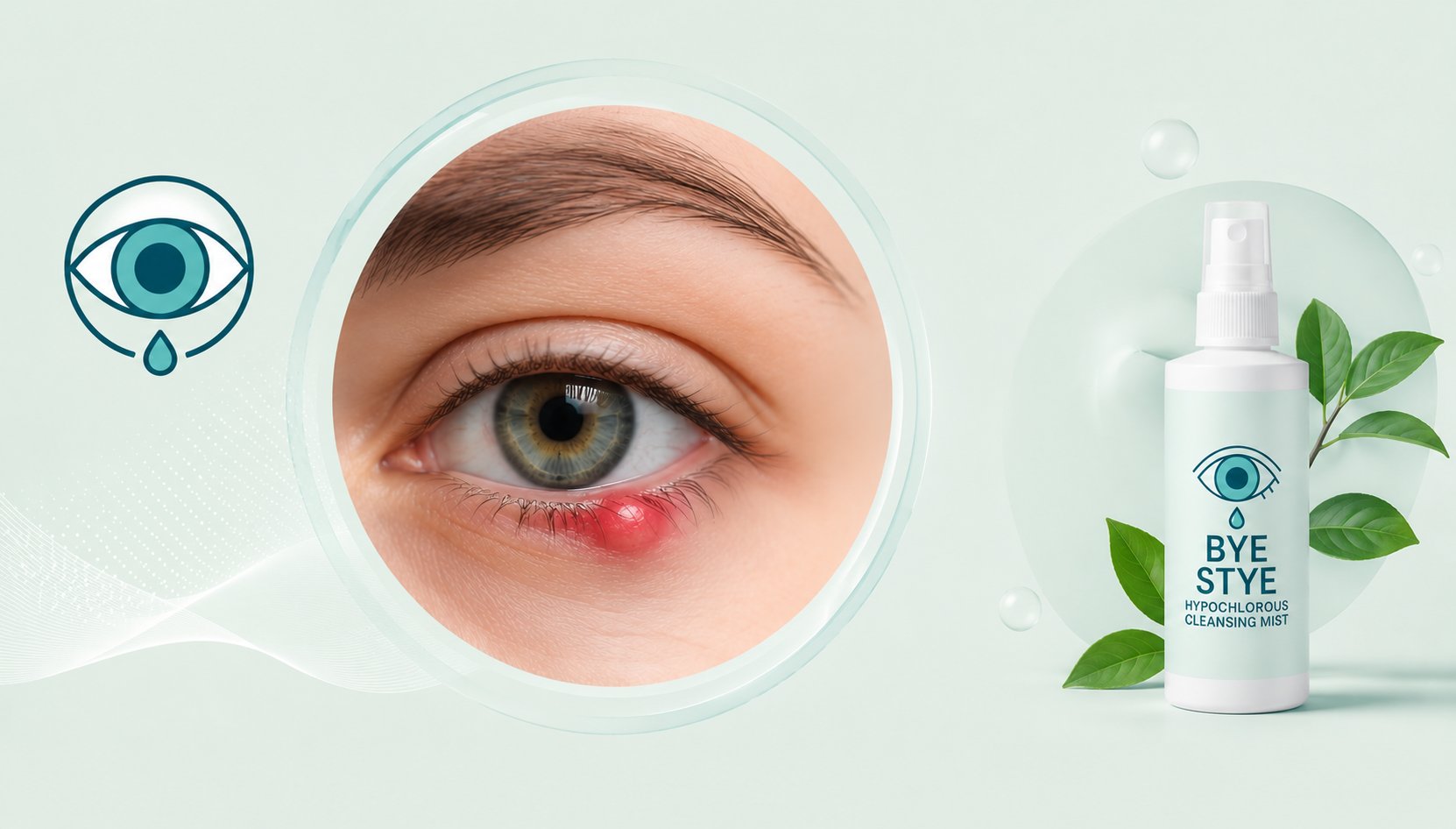
Your eyelids are lined with tiny oil-producing glands. The meibomian glands sit along the lid margin behind your lashes and release the oily layer of your tears. Smaller glands sit at the base of each lash. When one of these glands becomes blocked, the oil cannot escape, bacteria that live harmlessly on the skin multiply inside the trapped oil, and the result is the swollen, red, tender lump we call a stye.
Here is the important part: the blockage happens in a specific gland, not across the whole eyelid. Once that gland has been inflamed, its opening can be left narrowed or scarred, making it far easier for oil to back up in exactly the same place again. That is why your stye keeps coming back in the same spot rather than moving around.
Why Does My Stye Keep Coming Back in the Same Spot? The Six Most Common Reasons
1. The Original Gland Never Fully Cleared
A stye can look like it has healed on the surface while a small plug of thickened oil remains inside the gland. The moment your oil becomes slightly thicker — after a long flight, a poor night's sleep, or a week of late nights — that residue blocks the duct again. This is the single most common reason for a stye returning to an identical location.
2. Underlying Blepharitis or Meibomian Gland Dysfunction
Chronic low-grade inflammation of the lid margin (blepharitis) makes the oil in your glands thicker and stickier, and it encourages bacterial build-up along the lash line. If your lids are often crusty in the morning, slightly red along the edge, or feel gritty by the afternoon, blepharitis is very likely the engine driving your recurring styes. This is exactly the situation our BYE BLEPH biodegradable eyelid cleansing wipes were formulated for — single-use sachets infused with electrolysed water and gentle cleansing agents that lift debris from the lash line without preservatives, alcohol or fragrance.
3. Eye Makeup Sitting on the Lid Margin
Eyeliner applied along the waterline, long-wear mascara, lash extensions and lash glue all sit directly over the gland openings. Even a small amount left behind overnight can act like a cap on the duct. If your recurring stye is always on the lower lid where you tuck your liner, or at the outer corner where extensions are heaviest, this is almost certainly a contributing factor.
4. Touching, Rubbing and Squeezing
Rubbing itchy eyes transfers bacteria from your hands straight onto the lid margin, and squeezing a stye can push infected material deeper into the surrounding tissue. Both make a repeat episode in the same area far more likely.
5. Dry Eyes Creating a Vicious Circle
When your tear film is unstable, your glands are already under strain and your eyes feel itchy — so you rub them more. Screen-heavy days, air conditioning and the recycled air on flights all make this worse. Supporting your tear film with a clean, preservative-free hydrating eye drop formulated with 0.1% sodium hyaluronate means less irritation, less rubbing and less pressure on the glands. It is also safe alongside contact lenses, which matters if lens discomfort is part of your daily routine.
6. Reusing or Ignoring Everyday Items
Old mascara wands, unwashed pillowcases, shared face towels, reused makeup sponges and sleeping in contact lenses all reintroduce bacteria to the same eyelid, night after night. Recurrence in the same spot is often simply recurrence of the same habit.
The Routine We Recommend to Break the Cycle
Treating a stye is one thing. Stopping it from returning is a different job, and it depends almost entirely on consistency. This is the three-step routine we suggest to anyone whose stye keeps reappearing in the same place.
- Warm compress, twice daily. Apply a clean, comfortably warm compress to the closed lid for 5–10 minutes. Heat softens the thickened oil so it can flow out of the gland instead of setting inside it.
- Gentle lid cleansing, every day — not just during a flare. This is the step most people skip, and it is the step that prevents recurrence. Cleanse along the lash line to remove the debris and bacterial build-up that block the gland in the first place.
- Mist and support the skin barrier. Finish with a hypochlorous mist to leave the lid area clean and calm without stripping it.
Our BYE STYE Hypochlorous Facial Mist (100ml, £14.99) was designed for precisely this final step. It contains one thing: electrolysed purified water containing hypochlorous acid — the same naturally occurring compound your own white blood cells produce to fight bacteria. It is alcohol-free, fragrance-free, preservative-free and pH-balanced, and it has been dermatologist- and ophthalmologist-tested for sensitive skin.
Hold the bottle 15–20 cm from your face, close your eyes, mist evenly across the lids and lashes, and let it air dry. No rinsing, no wiping. Two to three times daily, or as advised by your eyecare provider.
You can find step-by-step directions for every product in our how to use our products guide, and a full ingredient and safety breakdown on our ingredients page.
Why Hypochlorous Acid Suits Recurring Styes So Well
Recurring styes need a preventative product you can use every single day without irritating the delicate skin around your eyes — which rules out harsh antibacterial cleansers and heavily fragranced micellar waters. Hypochlorous acid works differently:
- It is naturally antimicrobial, so it reduces the bacterial load sitting on the lid margin between flare-ups.
- It supports rather than strips the skin barrier, so the lid skin stays comfortable with repeated use.
- It is gentle enough for the most sensitive skin types and safe for daily long-term use around the eyes and face.
- It leaves no residue to clog the gland openings you are trying to keep clear.
For external use only — mist onto closed lids and never spray directly into an open eye. Each bottle carries a six-month period-after-opening symbol, and we recommend using it within that window for full effectiveness.
Making It Easy to Stay Consistent (and Kinder to the Planet)
Prevention only works if you keep going, so we have built our range around long-term daily use rather than one-off treatment. If you are starting from scratch, the BYE STYE Starter Kit (Cleanse + Refill, 100ml, £24.95) pairs a bottle with a refill so you are never caught without it. Once you know the routine works for you, our 200ml eco refill pouch (£18.95) tops up your existing bottle with far less plastic, and the three-bottle BYE STYE bundle (£35.99) is popular with households who want one at home, one in a bag and one at work. You can browse everything in one place in our full product collection.
Refills are a deliberate choice, not an afterthought. Reusing your bottle keeps packaging out of the waste stream, and it also makes the daily habit cheaper — which, in our experience, is what actually keeps people using it long enough to stop the cycle. You can read more about that commitment on our sustainability page.
When to See an Eyecare Professional
Daily lid hygiene prevents a great deal, but it is not a substitute for clinical care. Please book an appointment with your optometrist or GP if:
- The lump has not improved after two weeks of warm compresses and lid cleansing.
- It keeps returning to the same spot despite a consistent daily routine — a persistent lump in one location needs to be examined properly rather than assumed to be a stye.
- Your vision changes, or the swelling spreads across the lid, cheek or into the eye socket.
- You have significant pain, fever, or a hard painless lump that is slowly growing.
- You wear contact lenses and are experiencing repeated episodes.
We would always rather you were checked and reassured. Our products are designed to support your eye care, alongside professional advice — never instead of it.
The Short Answer
Your stye keeps coming back in the same spot because one particular gland in your eyelid remains blocked, narrowed or inflamed, and because the conditions that blocked it — thickened oil, bacterial build-up along the lash line, leftover makeup, rubbing, dryness — are still present. Warmth opens the gland. Cleansing keeps it open. Consistency is what finally breaks the pattern.
You can read more about why we started The BYE Co. on our about page, or find answers to the questions we are asked most in our FAQs. And if you would like personalised guidance, email us at info@thebyeco.co.uk — we read every message.

Written by Sanaan Akhter